 KWANJANGDO
DISCIPLINE • RESPECT • PERSEVERANCE
Traditional Korean martial arts in Randburg under 1972 Korean champion Grandmaster Eun Woo Lee. Build confidence, self-defense, discipline, and character for all ages.
WELCOME
Kwanjangdo is a trusted martial arts academy in Randburg for families, adults, and beginners seeking discipline, confidence, and practical self-defense.
Our youngest students are 4 years old and the eldest 72. There is no age limit for our martial arts programs, and all people both young and old can enjoy practical self-defense training that improves both physical fitness and mental strength.
Considering that Kwanjangnim is one of the very few that holds the 9th Dan rank in the world, all students benefit from his vast experience, advanced techniques and learn to share his passion for Martial Arts.
Kwanjangdo especially assists our youth in that they learn discipline, self-control, self-confidence and learn respect. This helps mould them into better members of society who become responsible and thrive on their self-achievements.
Our Academy has proved that once enrolled into our classes, the young generation show marked improvement as scholars and their attitudes and values change dramatically.
A few of our junior students have either learning disabilities or are hyper-active (a very common problem with children in South Africa). Kwanjangnim has helped many of these children in that he instills strict discipline, concentration and motor co-ordination into them. His training sessions are rigorous and at the end of each class he makes them sit on the floor (or lay down, whichever he prefers) and makes them close their eyes. He begins a ten minute meditation session in which he teaches them respect, honour, self pride and teaches them how to cope with their studies, pressures in life and helps them instill confidence into themselves and helps them understand just what they are capable of.
Many parents who have witnessed these sessions/classes have seen definite improvement in their children’s behavior. A few of the children have sadly suffered abuse in their lives and are trying to deal with their infliction and Kwanjangnim although strict, has a lot of compassion for these little people. Kwanjangdo Academy is also very popular among the female students both young and old. We find that most women wanted to learn how to defend themselves and Kwanjangnim puts them on a strict self-defense program incorporating Hapkido and Korean Kickboxing. Our female students that belong to our Academy are a definite force to be reckoned with and in these somewhat violent times, a woman needs to know basic self defense not only to protect herself but sometimes her family too.
Kwanjangdo is varied, never boring and offers cardio and stamina training as well as learning the history behind each Martial Art form.
For ten years he lived and trained in Swaziland whereby he taught the King of Swaziland, his Royal unit, the security and police forces as well as the National Team.
He then moved to South Africa and began teaching Taekwondo for a further ten years. He began Kwanjangdo five years ago, it is his own syllabus and he has incorporated Taekwondo (Olympic style), Hapkido, Gumdo, Korean Kickboxing and Tai Chi. It has grown tremendously in popularity not only in South Africa but in neighbouring African countries as well as the United Kingdom.
He currently holds the position of Technical Director of the Mozambique Taekwondo Federation, Technical Advisor for the Angolan, Swaziland, Gabon and Madagascar Taekwondo Federations as well.
He has dedicated his life to Martial Arts and he has trained, coached and refereed in 88 countries around the world.
His wife, Samonim Lorraine Lee who currently holds 1st Dan Black Belt (going for 2nd in December 2005) assists him in his Dojang and is the official coach for the Kwanjangdo Taekwondo Team during their championships.
Kwanjangdo Martial Arts Academy hosts an International Taekwondo Championship every year at their Dojang situated in Randburg, Johannesburg, South Africa.
All are welcome to come and join the first lesson for free and for more information, Kwanjangnim and Samonim Lee can be contacted here.
We look forward to seeing you.
KWANJANGNIM (관장님)
Grandmaster Eun Woo Lee
Kwanjangnim (Korean for "Grandmaster" or "Head of the School") Eun Woo Lee is the founder and chief instructor of Kwanjangdo Martial Arts Academy. As a child who faced bullying, martial arts transformed his life—giving him the physical skills to defend himself and principles to navigate life outside the dojo.
Accomplishments & Legacy
- 1972 Korean National Champion: Won top national honors in Korea before pioneering traditional Korean martial arts internationally.
- 2000 Sydney Olympics: Served as Team Manager for the South African Olympic Taekwondo team during Taekwondo's debut as an official Olympic sport.
- Master of Three Arts: Holds senior Grandmaster black belt ranks across Taekwondo, Hapkido, and Gumdo.
- Lifetime Educator: Has trained generations of students from young children to adult black belt instructors.
"Martial arts is not just about physical striking; it is a path to instill respect, focus, and indomitable spirit into daily life." — Grandmaster Eun Woo Lee
TAEKWONDO (태권도)
BACKGROUND
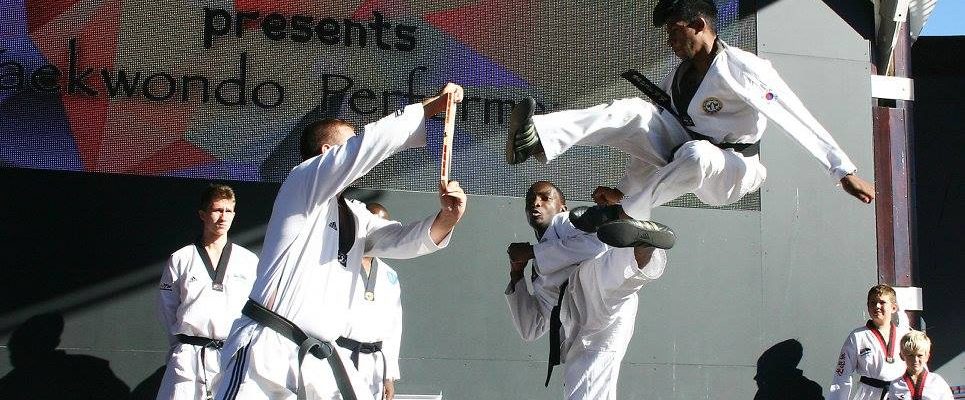
Taekwondo is a martial art and combat sport originating in Korea. One of the most widely practiced martial arts in the world, it is the national sport of South Korea and one form of sparring, shihap kyorugi, is an Olympic sport event. In Korean, ‘tae’ means to destroy with the feet; ‘kwon’ means to strike or smash with the hand; and ‘do’ means “path” or “way”. Hence, taekwondo is loosely translated as “the way of the feet and fist”. As with other martial arts, taekwondo combines combat technique, self-defense, sport, exercise, entertainment, and philosophy.
In general the art emphasizes kicks thrown from a mobile stance, using the leg’s greater reach and power to disable the opponent from a distance. In sparring, turning, front, reverse turning and side kicks are frequently used; advanced kicks include jump, spin, and skip kicks, often used in combination. Taekwondo training also includes blocks, punches, open-handed strikes, take-downs or sweeps, throws and some joint locks.
MODERN TAEKWONDO
By the end of the Korean War, nine martial arts schools had opened, and South Korean President Syngman Rhee ordered that the various schools unify under a single system. A governmental naming committee selected ‘tae-kwon-do’, possibly submitted by Choi Hong Hi, a general in the South Korean army and founder of the Oh Do Kwan. Following the official name submission on April 11, 1955, the Korean Taekwondo Association (KTA) was formed in 1959 to facilitate unification.
Standardization efforts continued over the following decades; the Kukkiwon (National Technique Center) was established and remains the World Taekwondo Headquarters. The World Taekwondo Federation (now World Taekwondo) formed in the early 1970s; the IOC recognized Taekwondo in 1980, it was a demonstration sport in the 1988 and 1992 Olympics, and became an official medal sport at the 2000 Sydney Olympic Games.
HAPKIDO (합기도)
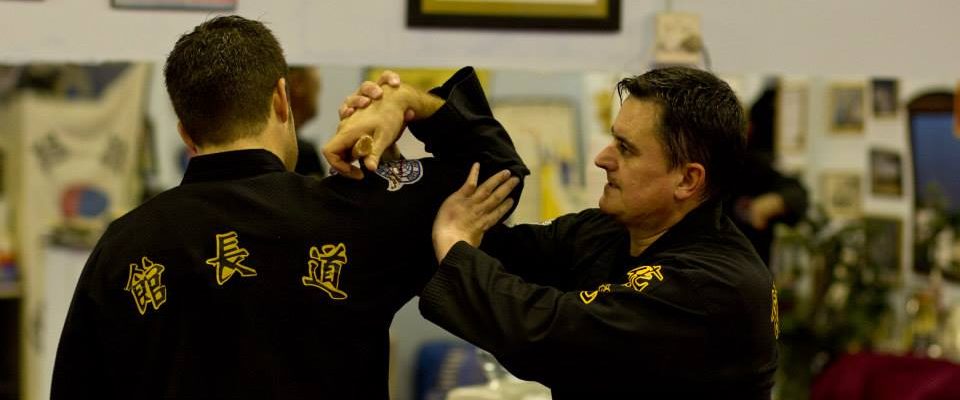
Hapkido is a dynamic and eclectic Korean martial art focused on effective self-defense. It employs joint locks, pressure points, throws, kicks, and other strikes. Hapkido practitioners train to counter the techniques of other martial arts as well as common unskilled attacks. Although Hapkido contains both long- and close-range fighting techniques, the purpose of most engagements is to get close for a strike, lock, or throw. Hapkido emphasizes circular motion, non-resisting movements, and control of the opponent, using footwork and body positioning to employ leverage rather than strength.
BACKGROUND
The birth of Hapkido can be traced to the efforts of Korean nationals in the post-Japanese colonial period, most notably Choi Yong Sul (1904–1986) and his prominent students. Choi spent time in Japan as a young boy and returned to Korea with techniques characteristic of Daito-ryu Aiki-jujutsu, a forerunner of aikido.
Modern Hapkido
Modern Hapkido avoids narrow specialization and maintains a wide range of tactics for striking, standing joint locks, throwing techniques, and pinning. Some schools include ground-fighting tactics, though most styles prefer to control a downed opponent from standing, half-standing, or a kneeling position.
Typical Hapkido tactics include using a kick or hand strike to bridge distance, grabbing the opponent's wrist or arm and applying a joint-twisting throw, controlling a downed opponent's elbow with one's knee to deliver a finishing strike, and using pressure points ("hyul") to create pain or unconsciousness that aids throws or joint manipulations.
Weapon Training
Hapkido also includes weapon training. Common weapons practiced include:
- Moo Ye Bong (Nunchaku)
- Bong Gum (Staff)
GUMDO (검도)
Gumdo is the traditional Korean art of the sword derived from ancient battlefield martial systems. Training builds extraordinary mental clarity, posture, core body power, precise cutting angles, and breathing control.
BACKGROUND
Koreans have a long history of formalized arts systems and the art of the sword is drawn from real experience in the battle field. (Haidong) Gumdo, is a name coined around 1982 and used for several Korean martial art organizations that use swords.
Practitioners of Haidong Gumdo engage in the practice of basic techniques (kibon), forms (gumbub), step sparring (yuksak daeryun), sparring (hada), sparring with live blades (jingeom gyeokgeom), energy building exercises (gi gong) and cutting practice (begi). Basic practice is done with the mokgum (wooden sword).
Modern Gumdo
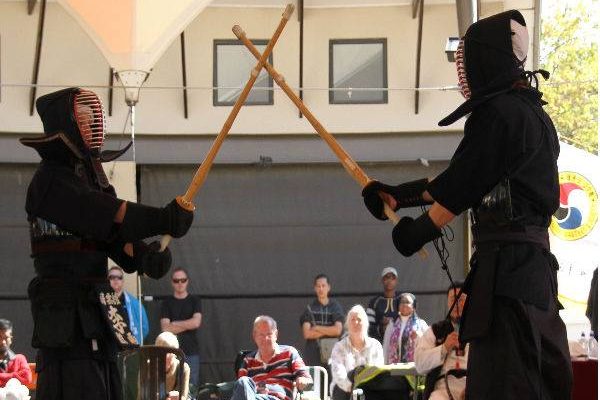
This Korean sword art which draws from battlefield tactics and techniques to build a curriculum for mental, physical and spiritual development. Students learn forms, step drills, sitting and moving meditation, sparring as well as bamboo and straw cutting. Unlike Kendo and its Korean equivalent, Kumdo, the focus in Gumdo is not dueling but on the tactics of outdoor, pitched battles.
Powerful, complex and beautiful, Gumdo is a wonderful style which can be pursued throughout your life.
Gumdo is fluid, dynamic and beautiful, but with a deadly purpose. With the emphasis on attaining the right mind for the proper use of the sword, students practice sword patterns, meditation, cutting and sparring techniques. Gumdo may be generally characterized as exchanging multiple strikes of the sword for one strike of the sword. The one strike concept characterizes the Japanese method. The Japanese ideal of “one strike, one kill” is prevalent in Japanese kendo (kumdo), even today. The merits and limitations of each of the philosophies may be debated endlessly. Probably the best way to characterize the main difference between Japanese kendo and the Korean Haidong Gumdo styles is through training philosophy:
- The Japanese technique primarily focuses on one-versus-one, or individual combat.
- The Korean technique primarily focuses on one-versus-many, battlefield combat.
Training Disciplines
- Bupbub (Forms): Traditional solo sword routines mastering stance work and draw angles.
- Mokgum (Wooden Sword): Practical partner drills and blocking techniques using wooden practice swords.
- Gekgum (Cutting): Precision target cutting (straw, paper, bamboo) to master edge control.
- Danjeon (Breathing): Lower abdominal breathing and mental focus conditioning.
TAI CHI (太極拳 / 태극권)
Tai Chi is a traditional Chinese martial art known for its slow, flowing movements and emphasis on balance, relaxation, and internal power. Originally developed as a system of self-defense, Tai Chi teaches practitioners to use timing, body alignment, sensitivity, and leverage rather than muscular strength.
BACKGROUND
The origins of Tai Chi are traditionally associated with Chen Village in Henan Province, China, where the Chen family developed the earliest known system. Over time, the art spread throughout China and evolved into several major styles, including Chen, Yang, Wu, Wu (Hao), and Sun.
Modern Tai Chi
Modern Tai Chi is practiced in two primary ways: as a health-promoting exercise and as a martial art. Martial Tai Chi emphasizes partner drills, push hands (Tui Shou), self-defense applications, and weapons training alongside the traditional solo forms.
Typical Tai Chi tactics include yielding to an incoming attack, redirecting the opponent's force through circular movement, unbalancing the attacker, and responding with a strike, joint lock, or throw. Rather than relying on speed or strength, practitioners develop sensitivity, timing, and whole-body coordination to control an opponent efficiently.
The principles of Tai Chi emphasize relaxation, precision, balance, and the efficient use of energy in both empty-handed practice and broader self-defense applications.
PHOTO GALLERY
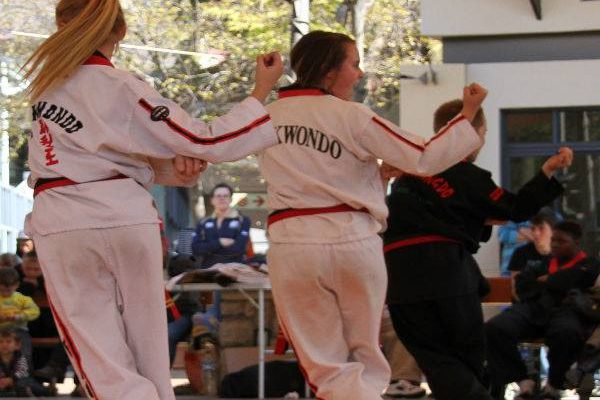
Inside Kwanjangdo in Randburg: training sessions, belt gradings, forms, and sparring at our martial arts academy.
BOOK A FREE TRIAL CLASS
Experience traditional Taekwondo, Hapkido, or Gumdo under expert instruction. Reserving a spot is fast and free.
OUR LOCATION
Visit us at our academy in Randburg or contact us by phone.
Address: 17-4 Hawken Laan, Bromhof, Randburg, 2154
Phone: 082 336 4653